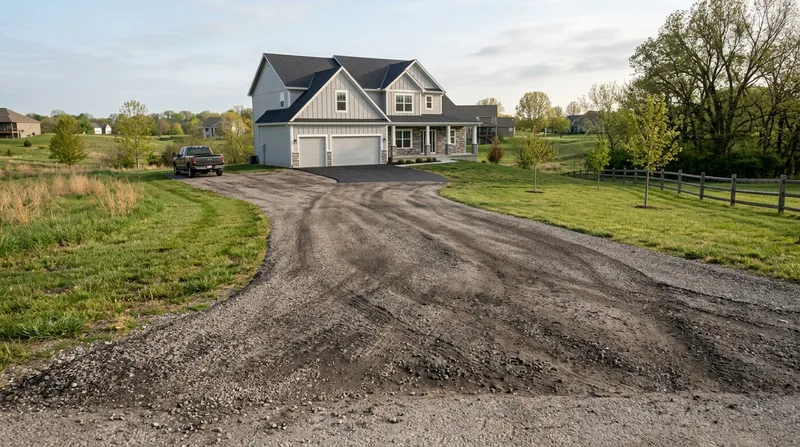




Recycled asphalt and millings driveways give Kansas City homeowners a stable, cost-effective base layer over the region's notoriously difficult silty clay. Greater Kansas City sits on wind-blown loess and clay that swells and shrinks through freeze-thaw cycles, often resting on limestone that leaves excavation uneven. Compacted recycled millings shed water on the sloped lots of the Northland and Lee's Summit subdivisions, provide a solid foundation for gravel lanes, and cost significantly less than a full hot-mix asphalt install. We grade and compact crushed millings into a surface that handles Kansas City's 36-inch frost line and the spring washouts that follow ice storms and heavy rain. This guide explains how recycled asphalt millings work in your climate, what the process costs, and how to hire a contractor you can trust.
Why Recycled Asphalt Millings Matter in Kansas City's Challenging Soil
Kansas City's older neighborhoods, Brookside, Waldo and the Plaza area, sit on early-1900s bungalows and brick Tudors built on narrow lots along streets that climb and dip with creek valleys. The Northland and South Kansas City bring mid-century ranches on wider, flatter lots, while newer subdivisions toward Lee's Summit and Liberty push longer driveways and three-car aprons across rolling ground that still drains toward creek bottoms. Every one of those driveways rests on clay that moves, and under that clay sits stone that comes close to the surface. Recycled asphalt millings compact into a stable base that resists the heave and washout that plague gravel and unprepped ground.
- We spread recycled millings and compact them in lifts to create a firm, well-draining base that sheds water on sloped lots.
- Millings lock together as they age and traffic passes over them, forming a surface harder than loose gravel but less expensive than hot-mix asphalt.
- The crushed stone base handles Kansas City's freeze-thaw swings and resists the alligator cracking that shows up when clay heaves under a rigid surface.
- Recycled millings work as a foundation layer under new asphalt, as a durable surface for rural driveways and private roads, and as a cost-conscious alternative to full-depth replacement.
A properly graded and compacted millings drive sheds water and holds up through multiple Kansas City winters, making it the smart choice for homeowners who need a functional surface without the cost of hot-mix asphalt.
Key info: Kansas City's clay-heavy soil means standard gravel settles unevenly and washes out in spring rains. Recycled asphalt millings interlock as they cure, resisting that movement and providing a stable surface that lasts years longer than loose stone. We handle the grading and compaction so the base sheds water properly and stays firm through the thaw cycle.
How We Install Recycled Asphalt Millings Driveways: The Kansas City Process
Recycled asphalt millings installation starts with understanding your lot's slope, drainage, and existing surface. We visit your property, measure the area, check how water moves across and away from your driveway, and look at what's already there. If you have an old gravel drive or failed asphalt, we clear and grade the base. We then spread crushed millings in compacted lifts, allowing the stone to settle and lock together. This process takes days to weeks depending on traffic and weather, but the result is a surface that handles Kansas City's spring washouts and winter heave far better than loose gravel.
- We grade the existing base, removing soft spots, rocks, and debris so millings have a firm foundation.
- We spread recycled asphalt millings in lifts and compact each layer with a roller to achieve proper density and drainage.
- We shape the surface for positive drainage, sloping it so water runs toward the street or a drainage swale and away from structures.
- We allow time for the millings to cure and lock together before the driveway sees heavy use.
- We verify compaction and thickness with a proof roll, confirming the base meets the specifications on your estimate.
Once complete, your recycled asphalt millings drive is ready for immediate light use, with full strength reached after a few weeks of settling and traffic.
Local example: A Lee's Summit homeowner with a 500-square-foot gravel drive that washed out every spring had us grade the lot, spread four inches of compacted recycled millings, and shape the surface to drain toward the street. Two years later, the drive has not settled unevenly and sheds water cleanly. The cost was roughly one-third of what a new asphalt driveway would have been, and the result handles the Northland's freeze-thaw better than loose stone ever would.
Recycled Asphalt Millings Installation Methods and Approaches
| Approach | Description | Best for |
|---|---|---|
| Millings as a standalone surface | Grade the lot, spread compacted recycled asphalt in lifts, shape for drainage, allow to cure. | Rural driveways, private roads, gravel lanes, and budget-conscious homeowners who want a durable alternative to loose stone. |
| Millings as a base layer under new asphalt | Compact recycled millings as the aggregate base, then overlay with hot-mix asphalt for a long-lasting paved surface. | Driveways and parking lots where you want the durability of asphalt but need to manage base preparation costs. |
| Millings over failed asphalt | Mill the old asphalt, grade the base, spread and compact recycled millings to restore drainage and stability. | Driveways with alligator cracking or base failure where the clay has heaved; millings allow movement instead of locking cracks in place. |
| Millings with reinforcement | Spread millings, compact, add a layer of larger recycled stone or gravel, then final millings lift for a multi-layer structure. | High-traffic private roads, HOA lanes, and driveways on very soft or clay-heavy ground where extra depth improves longevity. |
Each method is quoted on-site after we measure your driveway, check the soil, and understand your drainage needs. We provide written estimates with tonnage and depth specifications so you know exactly what you are paying for.
Recycled Asphalt and Millings Driveways Cost in Kansas City: What to Expect
Recycled asphalt millings driveways in Kansas City start at roughly $3 per square foot for a straightforward grade-and-compact job on a lot with good drainage and accessible ground. A 500-square-foot gravel drive conversion runs between $1,500 and $2,500 depending on how much grading is needed, whether we haul away old material, and how many lifts of compaction the clay base requires. Longer private roads, HOA lanes with multiple drainage issues, or lots where we must remove old asphalt or deal with heavy clay typically cost more because the base preparation takes more time and material.
Factors that move the price up include the following: soil conditions (if clay is soft or wet, we may need to excavate and replace it), the slope of your lot (steeper grades need more careful shaping and compaction), proximity to structures (we slow down and proof-roll more carefully near foundations), existing pavement or debris we must remove, and the total tonnage of millings your specific driveway requires. We measure on-site, calculate the tonnage and depth in writing, and give you a firm price before we start.
The best way to understand what your job costs is to call us at (816) 710-5361 for a free estimate. We will visit your property, explain what the soil and slope tell us, and provide a written quote with tonnage and specifications. Compare that quote with two or three other local contractors so you see how Kansas City pricing runs, and verify that each estimate includes depth, compaction method, and drainage details. See our full pricing overview for more context on how Kansas City asphalt and millings work fit into the broader driveway repair and replacement landscape.
Recycled Asphalt and Millings Driveways Near Me: What Kansas City Homeowners Should Know Before Hiring
Hiring a contractor for recycled asphalt millings work means verifying that the person or company you choose understands Kansas City's soil, has experience with grading and compaction, and will stand behind the work with a clear written contract. The historic fraud in driveway paving is the itinerant door-to-door crew with out-of-state plates offering to use leftover asphalt from a nearby job at a price that sounds too good. Honest guidance is the differentiator. When you are evaluating a contractor near Kansas City, check that they are local (verifiable address and Kansas City plates), ask for references from recent jobs in your neighborhood, and insist on a written estimate that includes tonnage, depth, compaction specifications, and drainage details.
Verify that any contractor you hire is fully insured and bonded. Ask to see a certificate of insurance and confirm that it covers liability and property damage. Do not pay a large cash deposit upfront; reputable contractors ask for a deposit only after signing a contract, and the balance is due on completion. If your lot requires a grading permit or a drainage approval from your city, ask your contractor to explain the permitting process and help you navigate it. Some Kansas City municipalities require permits for driveway extensions or for work that changes stormwater runoff, so verify with your local building department before you start. If you live in a master-planned community or an HOA, check your architectural guidelines to confirm that recycled asphalt millings are an approved material; some HOAs require hot-mix asphalt or concrete for visible driveways.
Get multiple estimates so you understand how Kansas City pricing works and can spot outliers. A quote that is far lower than the others may mean the contractor is cutting corners on compaction or using less material than the job requires. A quote that is far higher may reflect unnecessary work or a misunderstanding of what you are asking for. The right contractor will explain what they see in your soil, why the price is what it is, and what the finished driveway will look like and how long it will last. Call us at (816) 710-5361 for a free estimate, or visit our contact page to request a quote and discuss your specific needs.
Recycled Asphalt & Millings Driveways in Kansas City: Pricing Guide
| Service | Price | Details |
|---|---|---|
| Recycled millings drive, small lot (under 400 sq ft) | Starting at $3/sq ft | Grade, spread, compact millings in lifts; includes basic drainage shaping and proof roll. |
| Recycled millings drive, medium lot (400-700 sq ft) | Starting at $3/sq ft | Full grading, multi-lift compaction, drainage verification; cost rises if clay is soft or old asphalt removal is needed. |
| Recycled millings over failed asphalt or heavy clay | Starting at $4/sq ft | Includes milling or removal of old surface, excavation of soft spots, compacted millings base; longer timeline due to material handling. |
| Private road or HOA lane with multi-layer millings | On estimate | Requires on-site inspection of soil, slope, drainage, and traffic volume; tonnage and depth quoted after measurement and site assessment. |
| Travel and estimate | Included and Free | No mileage fee within Kansas City and surrounding service areas; free estimate with written tonnage and depth specifications within 24 hours. |
Indicative pricing, the exact cost depends on square footage, finish, and site access. Free personalized estimate within 24h at (816) 710-5361.


