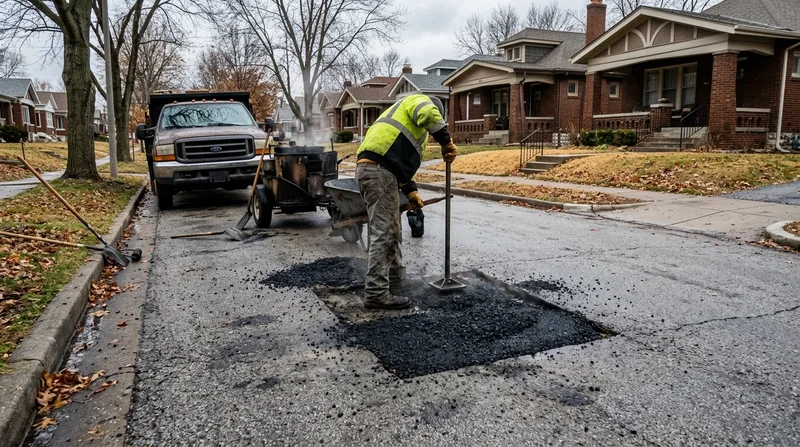




Kansas City's freeze-thaw cycle is relentless. Winter cold and spring warmth work together to heave asphalt sitting over the silty clay that underlies Brookside, Waldo, the Plaza, and neighborhoods across Jackson and Clay counties. Once frost lifts and water seeps beneath a weakened slab, potholes open fast, and a small crack becomes a hazard by April. Pothole repair and asphalt patching in Kansas City is not cosmetic work; it is the difference between a driveway that holds another five years and one that fails completely. We cut clean edges, tack the joint, and pack hot mix so the patch holds through the hard winters and wet springs that define this region. The work is straightforward, the material is proven, and the cost is a fraction of what full replacement will be.
Why Potholes Form So Fast in Kansas City: The Geology Behind the Problem
Kansas City sits on wind-blown loess and silty clay that swells when wet and shrinks when dry. Limestone and shale lie close to the surface in many neighborhoods, and that constant movement under an asphalt surface creates stress. When water gets under a slab and freezes, it expands; when it thaws, voids open up. A small crack becomes a pothole in a single hard winter. The freeze-thaw cycle can repeat twenty or thirty times between December and April, and each cycle weakens the bond between asphalt and base.
- Water infiltration under asphalt accelerates pothole formation during Kansas City's freeze-thaw swings.
- Silty clay substrate moves seasonally, creating stress on the asphalt surface above it.
- Older neighborhoods with shallow bases are hit hardest; newer subdivisions with proper compacted stone see fewer failures.
- Patching stops the spread and prevents the surrounding asphalt from breaking apart into the pothole.
Ignoring a pothole costs money. Water spreads under the edges, and alligator cracking radiates outward, turning a two-foot repair into a twenty-foot problem in one season.
Key info: In older Kansas City neighborhoods like Brookside and Waldo, where driveways climb and dip with creek valleys, potholes often appear first at the low point where water collects. A single hard winter can open multiple potholes in the same driveway. Early spring is the most common time to call, but the damage starts in January.
For more on how base preparation prevents these failures, see our page on driveway repair in Kansas City.
How We Patch Potholes and Asphalt Cracks: The Process That Holds
A temporary patch fails because it does not bond. We do not fill potholes with loose asphalt and hope. Instead, we cut the damaged area to clean edges, clean out debris and standing water, apply a tack coat to the sides and base, and pack hot mix asphalt in layers. The tack coat is the critical step; it bonds the new asphalt to the old, so the patch does not separate when the clay underneath moves or water pressure builds. In Kansas City's climate, a properly tacked patch holds through multiple freeze-thaw cycles and lasts five to ten years if the base underneath is stable.
- We cut the pothole or failed area to clean, square edges so the new patch fits tight and bonds evenly.
- We clean out all loose asphalt, debris, and water so the tack coat can bond the new material to the old surface.
- We apply a hot tack coat to the sides and floor of the cut so the new asphalt does not separate when the clay shifts.
- We pack hot mix asphalt in compacted layers to the original elevation, tamping each layer so it bonds to the one below.
- We allow the patch to cool and cure before traffic returns, typically within a few hours on warm days.
The difference between a patch that holds and one that fails is preparation. Skipping the tack coat or cutting loose edges means water will find its way back under the patch within months.
Example: A homeowner in Independence found a three-foot pothole in the middle of their driveway in March. The base under it was still solid; only the top two to three inches of asphalt had failed. We cut the edges square, tacked the joint, and packed hot mix. That patch is still holding three years later. If the base had been soft or broken, we would have recommended a larger repair or resurfacing instead.
When the damage is extensive, patching is not the best use of money. See our page on asphalt resurfacing and overlay for when a full surface repair makes more sense than patching individual holes.
Pothole Repair and Asphalt Patching Methods: Which Approach Works Best
Not all potholes are the same, and not all patches are equal. A small surface crack needs different work than a deep pothole with a soft base. The method we choose depends on the size of the failure, the condition of the base, and how much of the driveway is already compromised. A single isolated pothole on a solid base is a candidate for patching. Widespread alligator cracking or multiple potholes across the surface usually means the base is failing, and patching will be temporary.
| Approach | Description | Best for |
|---|---|---|
| Pothole Patch | Cut clean edges, tack, and pack hot mix asphalt in compacted layers. | Single or scattered potholes on a solid base with no alligator cracking nearby. |
| Full-Depth Patch | Remove failed asphalt and weak base material, replace with compacted stone and new asphalt. | Pothole with a soft or broken base underneath, or an area larger than two feet. |
| Spray Injection Patch | Clean the pothole and inject a liquid binder and aggregate slurry under pressure to fill voids and bond the repair. | Shallow potholes or edge breaks where the base is still sound and a quick turnaround is needed. |
| Resurfacing or Overlay | Mill or clean the entire surface and lay new asphalt over the existing base. | Multiple potholes, widespread alligator cracking, or more than thirty percent of the surface failed. |
A pothole patch costs less upfront, but if the base is compromised or the driveway is already showing alligator cracking, patching is a temporary fix. We will tell you when a patch is appropriate and when your money belongs in a larger repair.
Pothole Repair and Asphalt Patching Cost in Kansas City: What to Expect
A typical pothole patch starts at $450 and moves up from there depending on the size of the failure, the condition of the base, and whether we need to remove and replace base material. A single two-foot pothole with a solid base is on the lower end. A five-foot area with a soft base or multiple potholes in the same section will cost more. If we need to remove asphalt and base, compact new stone, and pack new hot mix, the price rises. The best way to know the actual cost is to get a written estimate on site, where we can see the depth of the failure and the condition of what is underneath.
Factors that affect the cost include the size and depth of the failure, the condition of the base underneath, the number of potholes in the same area, and whether we need to remove and replace base material. A small surface pothole on a solid base is quick work. A large pothole with a soft or broken base takes longer and costs more because we have to excavate, replace stone, and compact before we can patch the asphalt. Multiple potholes in the same section may be cheaper per hole if we can do them together than if we patch them one at a time.
We provide written estimates with tonnage and thickness specs so you know exactly what you are getting. Get two or three estimates from different contractors if you want to compare. Make sure each estimate includes the size of the patch, the depth of the work, and whether base replacement is included. A price that seems too good is usually incomplete; it may not include base work or tack coat, and the patch will fail.
For a full breakdown of our pricing across all services, visit our pricing page.
Pothole Repair and Asphalt Patching Near Me: What Kansas City Homeowners Should Know When Hiring
The most important thing to verify when hiring any contractor is that they are fully insured and that they provide a written contract before work starts. In Kansas City and across Missouri, the city or village sets permitting and contractor registration requirements; they vary from one jurisdiction to another. Before you hire anyone, check with your city or village building department to confirm what is required in your area. If your driveway is in an HOA community, check your architectural guidelines; some HOAs restrict asphalt patching or require approval before work begins. Get multiple estimates so you can compare scope, materials, and price. Ask for references and call them; a contractor who has done good work in your neighborhood will have happy customers nearby.
- Verify that the contractor carries general liability insurance and provide you with a certificate of insurance before work starts.
- Get a written estimate that spells out the size of the patch, the materials used, the depth of the work, and the total price.
- Check with your city or village to confirm whether a permit is required for pothole repair or asphalt patching in your area.
- If you live in an HOA community, confirm that asphalt patching is allowed and whether approval is needed before the work begins.
- Ask for references and call at least one or two homeowners who have had similar work done, especially in your neighborhood.
- Avoid contractors who show up unsolicited, offer a large cash discount, or ask for a large deposit before work starts.
A local contractor with Kansas City plates and a local address is a stronger signal than a traveling crew. The historic fraud in driveway paving is the door-to-door pitch: "We have leftover asphalt from a job nearby, and we can give you a deal today." Honest work is done under a written contract with a local company you can call back if something goes wrong.
Call us at (816) 710-5361 for a free, no-obligation estimate. We have been in business since 2013, and we serve Kansas City and the surrounding areas.
Pothole Repair & Asphalt Patching in Kansas City: Pricing Guide
| Service | Price | Details |
|---|---|---|
| Single Pothole Patch | Starting at $450 | Small pothole on a solid base, clean edges, tack coat, and hot mix compacted in place, typically two to three hours. |
| Multiple or Large Potholes | Starting at $750 | Two or more potholes in the same area, or a pothole larger than three feet, including site assessment and base condition evaluation. |
| Full-Depth Patch with Base Replacement | Starting at $1,200 | Pothole with soft or broken base underneath, removal of failed asphalt and stone, compacted replacement base, and new asphalt layer. |
| Multiple Areas or Extensive Damage | On estimate | Widespread alligator cracking, multiple failed sections, or base-level concerns that require site evaluation before a firm price can be quoted. |
| Travel | Included | No separate mileage charge or call-out fee within Kansas City and surrounding areas throughout the service zone. |
| Estimate | Free | Written estimate with tonnage and thickness specs, no obligation to book, response within 24 hours at (816) 710-5361. |
Indicative pricing, the exact cost depends on square footage, finish, and site access. Free personalized estimate within 24h at (816) 710-5361.


