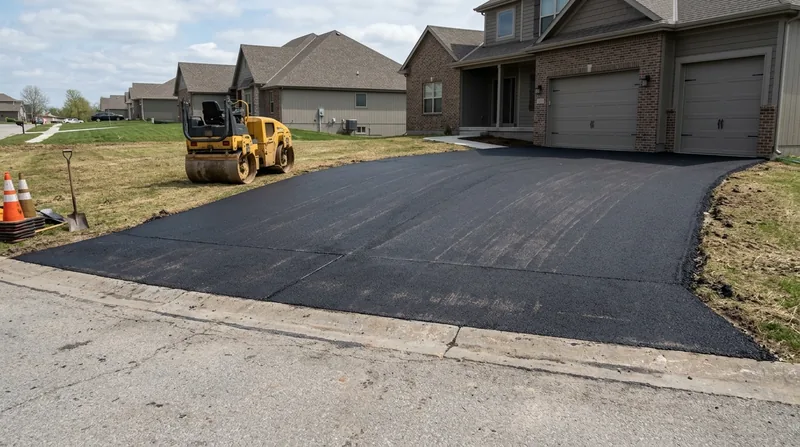




Homeowners across Kansas City and the suburbs are adding width and length to their driveways to fit modern three-car garages, wider turning radii, and parking aprons that handle the freeze-thaw cycles of our winters. The rolling lots of Lee's Summit and Liberty, the narrow brick-lined streets of Brookside and Waldo, and the mid-century ranch neighborhoods of the Northland all share the same challenge: existing driveways laid forty or fifty years ago were built to narrower standards. When you need driveway extensions, widening and aprons in Kansas City, the work goes beyond adding fresh asphalt. You need proper grading for drainage, a compacted aggregate base that will hold through the 36-inch frost line, and a butt joint between old and new that stays tight through hard winters and spring thaw. Kansas City Asphalt Paving handles that work on the local terrain we know: the silty clay and wind-blown loess under older neighborhoods, the limestone outcroppings that complicate grading, and the creek-valley drainage patterns that govern how water moves off your lot. We tie new asphalt flush to the old edge, grade for positive drainage away from structures, and finish with a joint that holds.
Why Driveway Extensions and Aprons Matter in Kansas City's Older and Growing Neighborhoods
Driveways built in the 1960s and 1970s were often 10 feet wide and 20 feet deep, designed for single-car garages and street parking. Today's homes have three-car garages, two or three vehicles per household, and delivery trucks that need turning room. An extension or widening adds usable parking and eliminates the spillover onto the street. On Kansas City's sloped lots, grading becomes critical. Water that pools at the joint between old and new asphalt will freeze, heave, and crack the new section within a season. Proper base preparation, compaction, and drainage are the difference between an apron that holds for fifteen years and one that fails in three.
- Widening a 10-foot drive to 12 or 14 feet gives you space for a second car and room to open doors without hitting the landscaping or fence.
- Extending the apron forward adds parking or turning radius, especially on corner lots where the street is narrow.
- Proper grading ensures water runs away from the house and garage, preventing pooling and freeze-thaw damage at the joint.
- A compacted aggregate base under the new section ties the old and new together, preventing edge cracking and settlement.
- Butt joints and taper cuts are finished to shed water and handle the seasonal expansion and contraction of asphalt.
An extension or widening is one of the highest-value improvements you can make to a driveway, and it often costs less than a full replacement of the entire drive.
Local example: A Brookside homeowner with a 1920s Tudor on a narrow lot widened the drive from 10 to 12 feet and extended the apron 8 feet forward. The old drive was sound, the base was good, and the clay soil drained toward the street. Total cost was $2,400 for 480 square feet of new asphalt, 4 inches thick, over a 4-inch compacted base. The same homeowner would have paid $6,500 for a full replacement of the entire 1,200-square-foot drive.
Before you schedule any excavation or grading, check with your city or village building department. Driveway aprons, culvert work, curb cuts, and impervious-surface limits are set by the municipality. Some jurisdictions require a permit; others do not. If your lot is in an HOA, check the architectural standards for material and size restrictions. Missouri law requires a utility locate through Missouri 811 before any digging begins, and that call is free and mandatory. See your local city or county building department website for permit requirements and the 811 number for your area.
How We Build Driveway Extensions and Aprons: The Kansas City Process
Extending or widening a driveway on Kansas City's variable terrain requires careful sequencing. The old asphalt edge must be prepared, the new subgrade graded and compacted, and the new base and asphalt laid so that water sheds away from the old section and the house. We start with a site visit to understand the slope, the condition of the existing drive, soil type, and drainage patterns. On the silty clay and loess common in older neighborhoods, we often find uneven bedrock close to the surface, which means grading is not uniform from one end of the extension to the other. We account for that in the base preparation.
- We call Missouri 811 to locate utilities and mark gas, electric, water, and sewer lines before any excavation.
- We mill or saw-cut the existing asphalt edge to create a clean, vertical face for the new section to bind to.
- We excavate and grade the subgrade for the extension, sloping it away from the house and existing drive at 2 to 4 percent.
- We place and compact a 4-inch aggregate base (crushed stone) to the frost line and proof-roll it to ensure it will not settle.
- We lay new asphalt, typically 2 to 3 inches, and finish the joint with a taper or butt edge that sheds water.
- We compact the new asphalt with a vibratory roller while it is still hot, and we do not allow traffic until the asphalt has cooled and set.
The entire process typically takes one to three days, depending on the size of the extension and the weather. New asphalt must cure for at least 48 to 72 hours in cool weather before it can handle regular traffic. We do not seal new asphalt for six to twelve months, allowing it to cure fully and shed excess oils before a seal coat is considered.
Real example: A Lee's Summit homeowner needed to widen a 16-year-old drive from 10 to 12 feet and extend the apron 6 feet forward for a third-car space. The existing drive was in good condition with no cracking. We saw-cut the edge, graded and compacted the new subgrade, placed 4 inches of compacted base, and laid 2.5 inches of hot mix asphalt. The butt joint was finished with a slight crown to shed water. Total time on site was two days, and the homeowner waited four days before parking cars on the new section. Cost was $1,950.
For more details on how we prepare bases and handle grading on Kansas City's challenging soils, see our page on gravel driveway installation and grading.
Driveway Extension and Widening Approaches
| Approach | Description | Best For |
|---|---|---|
| Full-width extension | New asphalt added to the end of the existing drive at the same width, with proper grading and base. | Adding length for parking or turning radius without changing the width. |
| Widening on one or both sides | New asphalt added to one or both edges of the existing drive, with the old edge saw-cut and prepared for a clean joint. | Fitting a wider garage, adding a second parking space, or creating a turnaround on a narrow lot. |
| Apron extension with widening | New asphalt added both forward and to the sides, creating a larger parking or maneuvering area. | Corner lots, three-car garages, or homes where street parking is limited and on-lot parking must expand. |
| Overlay-and-extend method | If the existing drive is worn but sound, we can overlay it with new asphalt while extending the apron, creating a unified surface. | Aging driveways that need both extension and a refreshed top layer, and where the base and subgrade are still solid. |
Driveway Extensions, Widening and Aprons Cost in Kansas City: What to Expect
The cost of a driveway extension or widening in Kansas City depends on the size of the new section, the condition and preparation of the existing drive, soil type, grading difficulty, and whether the work includes both widening and lengthening. A simple 480-square-foot extension (12 feet wide by 40 feet long) over a prepared, level subgrade typically starts at $1,800 to $2,400. A widening project that requires saw-cutting the existing edge, careful grading, and compaction on clay or silty soil may run higher. An apron that combines both widening and extension, or that requires significant grading on a sloped lot, can reach $3,500 to $5,000 or more.
The main factors that affect cost are the total square footage of new asphalt, the difficulty of grading and base preparation (especially on clay and loess soils common in older Kansas City neighborhoods), the condition of the existing drive edge, and whether utilities or structures require special care. A narrow lot in Brookside with tight clearances to a house or fence may need more careful excavation and grading than a wide suburban lot in Liberty or Lee's Summit. Sloped terrain drains better but requires more precise grading to ensure positive drainage away from the house.
Get two or three estimates from local paving contractors. Each estimate should include the square footage of new asphalt, the thickness of the asphalt and base, the tonnage of material, and the estimated timeline. A written estimate with those details is the industry standard and protects you. For a detailed pricing overview and to discuss your specific project, visit our pricing page or call us at (816) 710-5361 for a free, no-obligation estimate.
Driveway Extensions, Widening and Aprons Near Me: What Kansas City Homeowners Should Know Before Hiring
Hiring a paving contractor for an extension or widening is a straightforward decision if you know what to look for. Start by verifying that the contractor is fully insured and carries liability and workers compensation coverage. In Missouri, licensing and permits are set by your city or village, not the state. Call your local building department to ask whether a permit is required for your driveway extension, what the rules are for impervious-surface limits and stormwater drainage, and whether you need an engineer's approval. If your home is in an HOA or master-planned community, check the architectural standards for driveway material, color, and size before you schedule work.
- Ask for a written estimate that includes square footage, asphalt thickness, aggregate base thickness, and total tonnage of material.
- Request references from three recent projects in your area, and follow up with at least one to ask about the quality of the work and whether the job stayed on budget and schedule.
- Verify that the contractor will call Missouri 811 before excavation and will show you the utility locate marks before digging.
- Ask whether the contractor will handle permitting or help you navigate the local process, and confirm who is responsible for pulling the permit.
- Avoid contractors who offer unsolicited door-to-door quotes, demand large cash deposits before work begins, or quote a price that seems too low to be real.
- Check that the contractor has local plates and a verifiable local address, not an out-of-state operation or a travelling crew.
A reputable local paving contractor will stand behind their work with a clear warranty on labor and materials, provide a detailed written contract before work begins, and be available to address questions or concerns after the job is done. For a free estimate and a conversation with a local contractor who knows Kansas City's terrain and climate, contact us today.
Ready to expand your driveway? Call Kansas City Asphalt Paving at (816) 710-5361 for a free estimate. We serve Kansas City, North Kansas City, Independence, Lee's Summit, Blue Springs, Liberty, and surrounding areas. We provide written estimates with tonnage and thickness specifications, and we handle all the grading and base work that keeps your extension tight through Kansas City winters.
Driveway Extensions, Widening & Aprons in Kansas City: Pricing Guide
| Service | Price | Details |
|---|---|---|
| Small extension (400-600 sq ft) | Starting at $1,800 | New 2.5-inch asphalt over 4-inch compacted base, includes grading, saw-cut edge, and butt joint finish |
| Medium extension or widening (600-900 sq ft) | Starting at $2,400 | Widening one or both sides, or extending 40-50 feet, includes excavation, base prep, and drainage grading on clay or loess soil |
| Large apron with widening and extension (900-1,200 sq ft) | Starting at $3,500 | Combines widening and forward extension for three-car parking or turnaround, includes significant grading on sloped terrain |
| Complex grading or difficult access | On estimate | Tight clearances, utilities, structures, or steep slopes require site visit to determine base prep and drainage strategy |
| Estimate and site visit | Free | Response within 24 hours at (816) 710-5361, includes measurement, grading assessment, and written quote with tonnage |
Indicative pricing, the exact cost depends on square footage, finish, and site access. Free personalized estimate within 24h at (816) 710-5361.


